You spend an hour on the range and go through a large bucket of range balls. You work through every club in the bag. You stripe a few irons in the middle of the session and think, okay, I’ve got something here. Then that much-anticipated Saturday morning round arrives, you go out, and have a repeat of the last five frustrating rounds.
The problem is not your commitment. The problem is how your brain actually learns a physical skill.
Scientists figured this out over a century ago. The U.S. military has been using it to train soldiers for decades. And it applies directly to why two ten-minute sessions at home with TrueGroove will do more for your ball striking than an afternoon beating balls with no real plan.

The Science Has Been Settled for a Long Time
In the 1880s, a German psychologist named Hermann Ebbinghaus documented what is now called the spacing effect. His research showed that information and skills are retained far more effectively when practice is distributed across multiple shorter sessions rather than crammed into one long block. He was studying memory, but motor learning researchers have spent the past hundred years confirming the same principle applies to physical skills.
The reason comes down to what happens between sessions. When you practice a movement and then stop, your brain keeps working. Sleep, rest, and the passage of time allow the nervous system to consolidate what it just experienced. Motor patterns get encoded more deeply during recovery than during the practice itself. The session plants the seed. The rest is where it takes root.
When you hit ball after ball for ninety minutes straight, you are not giving the brain time to do that work. You are fatiguing the muscles, which changes your mechanics as the session goes on. You are also losing the feedback loop. After the first twenty or thirty swings, most golfers stop feeling individual repetitions clearly. They are just swinging.
What the Military Learned About Skill Training
The U.S. Army and special operations community did not arrive at short, frequent practice sessions because it sounded good. They got there because training lives depend on skill retention under pressure, and they needed to know what actually works.
Research conducted for military marksmanship and combat readiness programs consistently showed that distributed practice outperforms massed practice for retention of motor skills. Soldiers who trained in shorter, more frequent sessions maintained their skill levels longer and performed more reliably under stress than those who trained in longer but less frequent blocks.
NASA came to similar conclusions in astronaut and pilot training. High-stakes motor skill acquisition requires repetition, yes, but repetition spaced out and tied to clear physical feedback, not volume for its own sake.
The pattern across all of this research is consistent: quality repetitions with feedback, distributed across time, beat high-volume sessions with no corrective mechanism.
What This Means on the Driving Range
The driving range mentality has a fundamental flaw built into it. You have a bucket of balls, and the implicit goal becomes hitting all of them. There is no feedback mechanism telling you whether each swing was correct or not. You are making your best guess based on ball flight, which is useful but incomplete. And once you start grooving a compensating move to get the ball airborne, you are practicing that compensation, not fixing the underlying fault.
By the time fatigue begins to set in, your mechanics have drifted from where they were when you started. You may actually be reinforcing bad habits in the back half of the session without knowing it.
This is not a knock on range work entirely. Range time has a place. But unstructured, high-volume range sessions without a corrective feedback tool are not the fastest path to a better swing. The research says so pretty clearly.
Why TrueGroove Changes the Equation
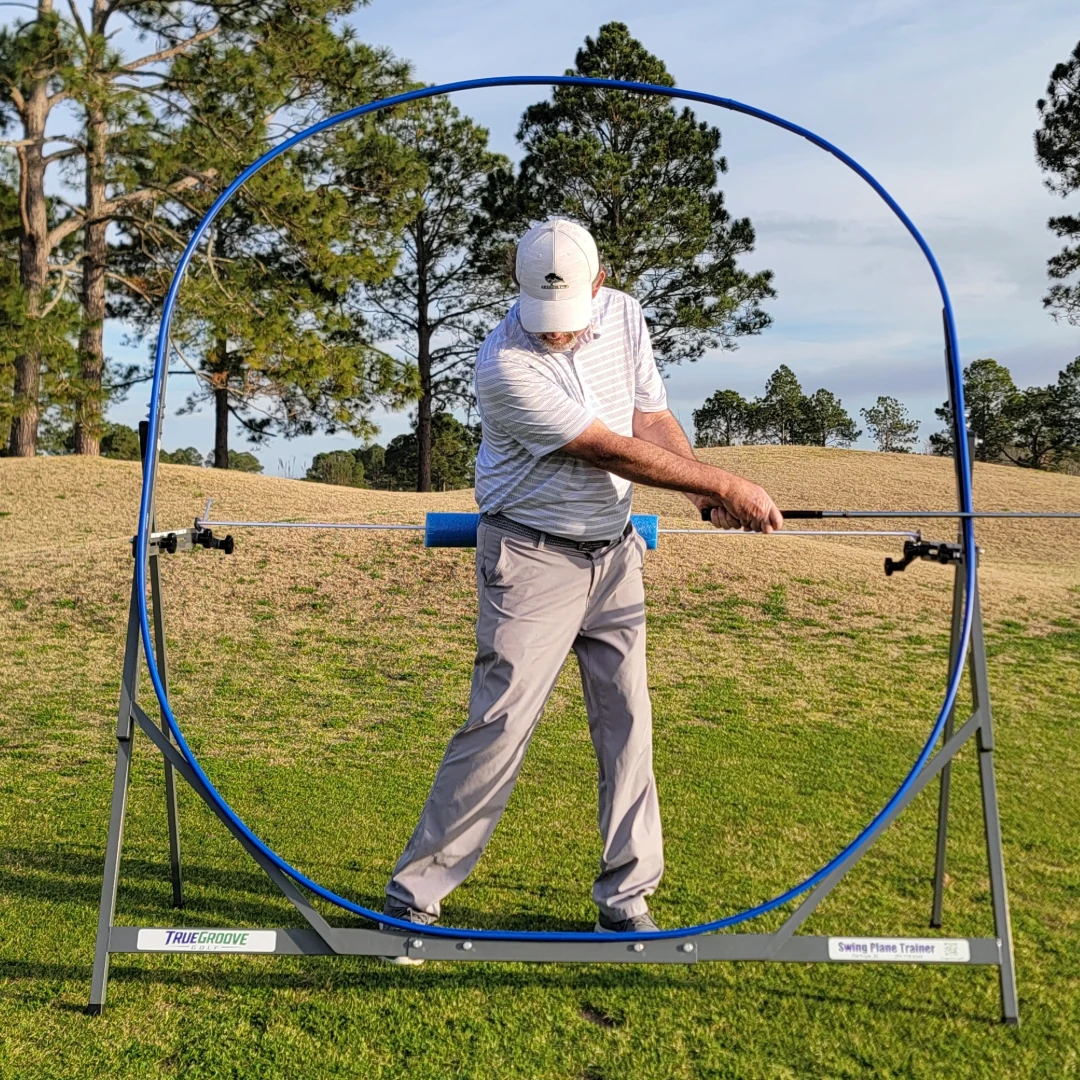
Ten minutes with TrueGroove is not like ten minutes of aimless practice swings, or ten minutes on the range. The device gives your nervous system something it rarely gets: an immediate physical reference for what correct feels like.
The Poly-Glide Plane Rail keeps the club traveling on the correct swing plane. You are not guessing whether your takeaway was on plane or whether you came over the top. You feel it, or you feel the resistance that tells you something is off. That feedback loop is exactly what the motor learning research says the brain needs to encode a new movement pattern.
The Power Bar addresses early extension, one of the most common and damaging faults in amateur golf. It sits at glute level and the goal is simple: maintain contact throughout the swing. If you lose contact, your body has told on itself. No video analysis required. The feedback is immediate and unmistakable.
Two ten-minute sessions a day with that kind of feedback gives your nervous system what it needs. A clear, repeatable physical reference. Enough time to encode the movement without fatiguing into compensation. And the space between sessions for consolidation to happen.
That is not a theory. That is how motor learning actually works.
What Two Sessions a Day Can Do
Morning session, ten minutes. Before work, before the day gets complicated. A focused block of repetitions with TrueGroove, no ball required. Start slow and deliberate, feeling the Poly-Glide Rail and the Power Bar giving you honest feedback on every swing. As the movement starts to click, you can work up to full-speed swings. You are training the pattern, not chasing a result.
Evening session, ten minutes. Same thing. Your brain spent the day in between quietly consolidating what you did in the morning. You are reinforcing the pattern, not starting over.
That is twenty minutes total. No drive to the range. No bucket fee. No standing in the heat wondering why the same miss keeps showing up.
Do that consistently for a few weeks, and then go to the range. You will notice the difference. Not because you hit more balls, but because the movement your brain has been encoding is now available to you when you need it.
The Golfers Who Improve the Fastest Share One Habit
It is not the ones who practice longest. It is the ones who practice smart and practice consistently. Short, focused sessions with clear feedback, repeated over time. That is the pattern whether you are a Special Forces soldier learning a new skill under pressure or a twelve-handicap trying to stop coming over the top.
TrueGroove was built for exactly this kind of practice. It does not require a range, a net, or even a ball. It requires ten minutes and the willingness to train the right way instead of the comfortable way.
TrueGroove is how you put that into practice starting today. No range trip. No ten dollar bucket of balls. Just ten minutes, twice a day, with a training aid that gives your swing the honest feedback it has never had before. Get your TrueGroove Swing Trainer and start training the way the science says actually works.