
All great ball strikers share two fundamental traits: an on-plane swing path and proper posture throughout the swing. Master these together, and everything else in your swing becomes easier. Lose either one, and you’ll spend years chasing fixes that never quite work.
What Is Swing Plane?
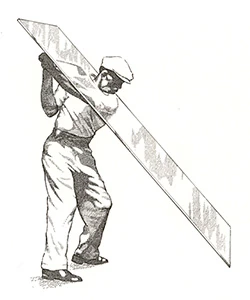
Think of swing plane as an invisible tilted pane of glass that your club should travel along throughout your swing. This angled plane extends from the ball through your shoulders and continues in an arc around your body. When your club stays on this plane, you’re giving yourself the best chance for solid, consistent contact and straight ball flight.
The ideal swing plane varies slightly depending on your height, club length, and body type, but the principle remains constant: the club should travel on a consistent path from takeaway through impact and into your follow-through.
Why Swing Plane Matters
A proper swing plane is crucial for several reasons:
Consistency: When your club follows the same path swing after swing, you develop repeatable results. This is the holy grail of golf.
Power: A club traveling on the correct plane naturally creates speed through proper sequencing and weight transfer. Fighting against your natural plane wastes energy.
Accuracy: The most common miss in golf is the slice, which occurs when the club approaches the ball from outside the target line. This outside-to-in path is almost always a swing plane issue.
The Posture Connection
Here’s what many golfers miss: your posture at address directly determines your swing plane. Poor posture makes it nearly impossible to maintain a proper plane throughout your swing.
Proper golf posture includes:
- A slight bend at the hips (not the waist)
- Knees flexed but not over-bent
- Arms hanging naturally from the shoulders
- Spine tilted slightly away from the target
- Weight balanced through the middle of your feet
When you establish this athletic position, you create the framework for your swing plane. Your spine angle becomes the axis around which your shoulders rotate, and this rotation defines your plane.
The Early Extension Problem
One of the most common swing plane killers is early extension. This happens when golfers lose their posture during the downswing, standing up or moving their hips toward the ball. When you extend early, you’re essentially changing your spine angle mid-swing, which forces your swing plane to shift.
The results are predictable: topped shots, thin contact, blocks to the right, or last-second compensations that lead to hooks. Many golfers develop elaborate fixes for these symptoms without addressing the underlying posture breakdown.
The Challenge of Feel vs. Real
The fundamental challenge with posture is that it’s difficult to monitor while swinging. You can feel like you’re maintaining your angles when video analysis reveals something entirely different. Understanding swing plane and posture intellectually is one thing. Ingraining the correct feelings is another entirely.
Most golfers need hundreds of repetitions to override old patterns, and those repetitions need to reinforce the correct positions. But how do you practice correctly when you can’t feel what you’re doing wrong?
Training with Immediate Feedback
This is where the TrueGroove Swing Trainer changes the game. Unlike mirror work or video analysis that only shows you what happened after the fact, TrueGroove provides instant physical feedback as you swing.
The Poly-Glide Plane Rail guides your club along the correct swing plane, so you’re not guessing whether you’re on plane or fighting old habits. You feel the proper path with every repetition, building muscle memory that transfers directly to the course.
But here’s where TrueGroove solves the posture problem that plagues so many golfers: the Power Bar. This horizontal bar sits at glute level during your swing. Maintain proper posture and you stay in contact with the Power Bar throughout your swing. Extend early, and you immediately feel the separation. There’s no wondering if you’re maintaining your spine angle. The feedback is instant and unmistakable.
This combination addresses both elements simultaneously. You’re grooving the correct swing plane while the Power Bar trains you to maintain the posture that makes that plane possible. It’s the interconnected system your swing needs.
Building a Better Swing
TrueGroove works with your own clubs, so the feel translates directly to your actual equipment. The adjustable plane angles mean you can train the correct plane for your driver, irons, and wedges. At 22 pounds, it’s substantial enough to stay stable during your swing but portable enough to use anywhere.
What separates TrueGroove from other training aids is this dual-feedback system. Other plane trainers might help with path, but they don’t address the posture breakdown that sends golfers searching for fixes. The Power Bar gives you awareness of something you literally cannot see while you’re swinging.
Bringing It All Together
Your swing plane and posture aren’t separate elements to work on individually. They’re interconnected parts of a complete system. Establish proper posture at address, maintain that posture throughout your swing, and your club will naturally travel on a more consistent plane.
The beauty of focusing on these fundamentals is that improvements here cascade into every other part of your game. Better plane and posture mean better contact, which means more distance, tighter dispersion, and lower scores.
Golf is a game of small margins. The difference between a handicap of 15 and single digits often comes down to consistency, and consistency starts with the fundamentals. Master your posture, respect your swing plane, and give yourself the feedback you need to make real, lasting changes.
Ready to transform your swing? Order your TrueGroove Swing Trainer today.